English
 简体中文
简体中文
 Deutsch

Kate Schuler, PhD
Application Scientist at Picarro
Picarro Spotlight is a blog series showcasing important scientific work from our customers around the world. Each blog is selected and summarized by our team. Enjoy!
In environmental, hydrological and medical research, preparation of small-volume water samples for precise isotopic analysis often requires distillation due to the presence of dissolved salts, electrolytes, and other impurities that can negatively impact data quality and sample handling mechanisms. Conventional offline purification techniques are labor-intensive, requiring continuous supervision, and are ill-suited to efficient batch processing of small samples. A study by Daisy Butera and colleagues at the University of Ottawa, showcases a new method designed specifically to overcome these hurdles, offering a reliable way to purify small-volume water samples (< 20 mL) while maintaining excellent quantitative recovery and preserving stable water isotopic ratios.
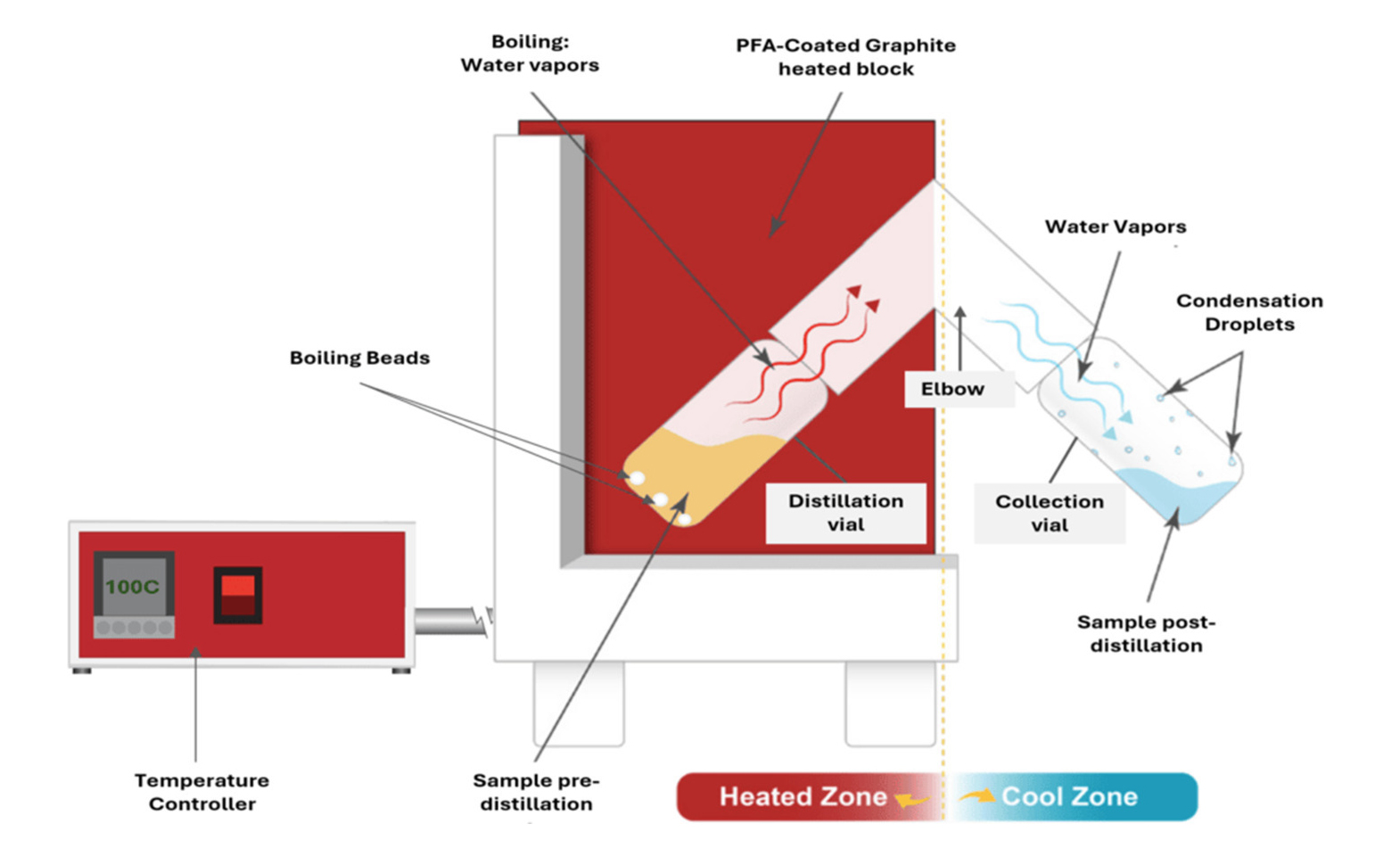
The technique uses an EvapoClean™ compact heating block and sealed vials in a fully closed, automated setup, distilling 12 samples at a time (Figure 1). The researchers note the achievement of excellent quantitative recovery, with gravimetric recovery ranging from 99.7% to 99.9%. Additionally, distillation of deuterium enriched samples did not demonstrate issues with carryover effects that could affect natural-abundance samples run afterwards. In their paper, distillation tests were performed over a period of 18 hours, though shorter distillation periods may be possible. Overall, the performance metrics of the system matched or were better than conventional distillation methods, demonstrating the method as a reliable way to efficiently and automatically purify small-volume water samples (< 20 mL) while maintaining excellent quantitative recovery and preservation of stable water isotopic ratios.
When combined with Picarro’s L2130-i and L2140-i Water Isotope Analyzers, this automated microdistillation approach enables cleaner, higher-throughput isotopic workflows, delivering reliable data from even the most challenging small-volume water samples and advancing our understanding of Earth’s water cycle.